NexusAI Data Platform
Welcome to the comprehensive documentation portal for the NexusAI Data Platform -- an enterprise-grade AI operating layer that connects your systems, builds semantic context, and deploys autonomous agents that reason and act across your organization.

Executive Summary
What is NexusAI?
NexusAI is the Intelligent AI Operating Layer for the Enterprise. Rather than replacing existing systems, NexusAI sits on top of your current technology stack -- CRMs, ERPs, data warehouses, and operational tools -- and unifies them into a single, AI-driven intelligence fabric. It transforms siloed enterprise data into connected, actionable knowledge that autonomous agents use to reason, decide, and execute.
How It Works
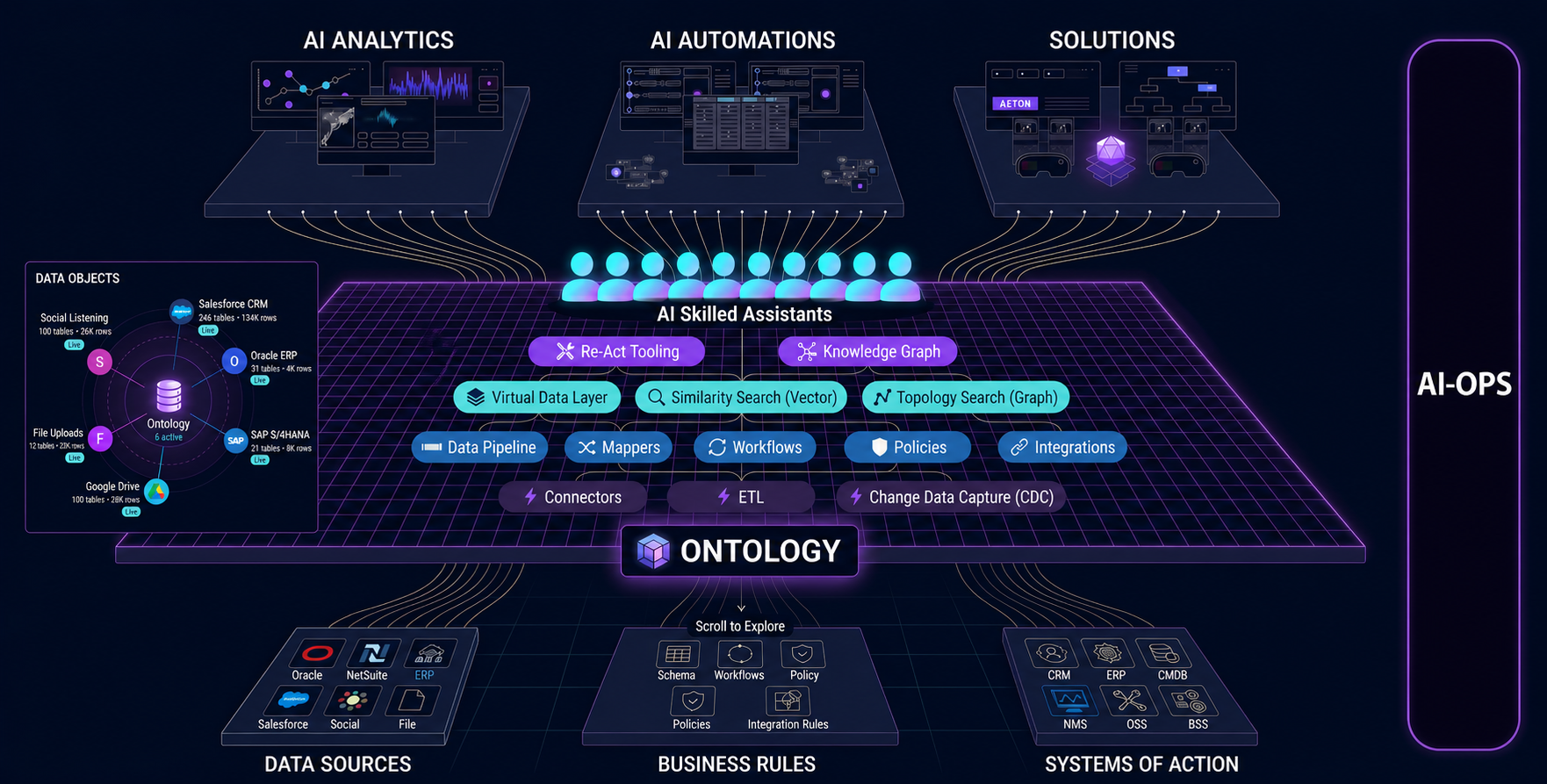
NexusAI operates through a four-stage pipeline that turns disconnected enterprise data into autonomous action:
| Stage | Description |
|---|---|
| Connect | Plug into existing enterprise systems -- CRM, ERP, data warehouses, SaaS tools -- via pre-built connectors and APIs. No data migration or system replacement required. |
| Map | Build a semantic knowledge graph that captures entities, relationships, and business context across all connected systems. |
| Reason | The AI Reasoning Engine applies structured reasoning (ReAct) across the connected knowledge graph to analyze situations, identify patterns, and determine optimal actions. |
| Execute | Autonomous agents carry out end-to-end workflows -- updating records, triggering processes, escalating exceptions -- with full auditability and human-in-the-loop controls. |
Key Capabilities
AI Engine for Ontologies
Distributed AI engine that runs any ontology as executable AI workloads -- data prep, model training, fine-tuning, inference, batch scoring, and real-time AI. Pluggable compute backends (CPU, GPU, TPU, Spark, Ray, Kubernetes) so the same ontology runs anywhere from a single node to a multi-region cluster.
AI-Ops Stack for Ontologies
Production-grade operating layer wrapped around every ontology and AI workflow: Observability, ML-Ops, Governance, Automation, and Optimization. Policy guardrails, audit trail, drift and cost monitoring, and lifecycle management built in -- not bolted on.
Enterprise Data Integration
Pre-built connectors for CRM, ERP, data warehouses, and SaaS platforms. Unified data access layer with real-time and batch ingestion. Zero-migration architecture -- NexusAI connects to systems in place.
Semantic Intelligence Layer
Automated knowledge graph construction from connected data sources. Entity resolution, relationship mapping, and contextual enrichment. A living semantic model that evolves as your data changes.
AI Reasoning Engine (ReAct)
Structured Reasoning + Acting framework for multi-step decision-making. Cross-system analysis that no single tool can perform alone. Transparent reasoning traces for auditability and compliance.
AI Analytics
Dashboards, Views, and the Four-Views framework (Outcomes / Predict / Diagnose / Monitor) auto-seeded for every Solution. Solution Mapping binds each View into the right Solution UI; the Dashboard Builder with the AI Query Builder turns natural language into Virtual Data Layer queries.
AI Automation
Journey engine for production workflows -- multi-step pipelines with persistent run history, audit trail, and Manual / Schedule / Webhook triggers. The AI Copilot Journey turns a plain-English goal into a draft journey; the Journey Builder offers visual authoring with a typed Tool Palette and per-step validation.
AI Simulators
Built-in enterprise data simulators (starting with the SFDC / CRM simulator) that let development and QA teams exercise the full Data Plane and Reasoning Plane without connecting to live external systems. In-memory stores backed by S3 dumps swap into the same FDW interface, so journeys, dashboards, and agents run unchanged.
Business Impact
| Metric | Impact |
|---|---|
| Workflow Automation | 40--60% of repetitive workflows automated across departments |
| Decision Speed | 50% faster data-driven decisions through unified context |
| Operational Cost Reduction | 30--40% reduction in operational overhead |
| System Replacement | Zero -- NexusAI overlays existing infrastructure without migration |
Applications
NexusAI delivers value across industries and functions:
| Domain | Use Cases |
|---|---|
| Customer Operations | Unified customer 360, intelligent case routing, proactive churn prevention |
| Revenue Operations | Pipeline intelligence, quote-to-cash automation, forecast accuracy |
| Supply Chain | Demand sensing, supplier risk monitoring, logistics optimization |
| Finance | Automated reconciliation, anomaly detection, regulatory reporting |
| IT Operations | Incident correlation, predictive capacity management, automated remediation |
| Healthcare | Patient journey orchestration, clinical workflow automation, compliance monitoring |
| Retail | Inventory optimization, personalized engagement, omnichannel orchestration |
| Telecommunications | Network analytics, service assurance, customer experience management |
Documentation
Business Documentation
Executive summaries, business requirements, and business cases that define the strategic value and objectives of the platform.
AI Operating System
Product requirements, functional specifications, and system design documents that describe how the AI operating layer is structured and behaves.
Features & Capabilities
Detailed documentation on platform capabilities, connector architecture, reasoning engine configuration, and agent frameworks.
Technical Documentation
Solution architecture, infrastructure requirements, integration guides, database design, and system internals.
Operational Documentation
Deployment guides, configuration management, monitoring, troubleshooting, and day-to-day operational procedures.
Developer Guide
Development environment setup, API documentation, SDK references, testing procedures, and contribution guidelines.
Quick Links
| Category | Quick Access |
|---|---|
| Get Started | Installation Guide |
| Architecture | Solution Architecture |
| Developers | Developer Guide |
| Business | Executive Summary |